Honing vs Sharpening: What the Difference Is and When to Use Each
Honing and sharpening are often mixed up. Honing keeps an edge straight between sharpenings, while sharpening removes metal to create a new edge. This guide explains each, how to tell which your knife needs, and how to do both safely.
Short answer
- Honing is light maintenance. It straightens an edge that has bent and, with an abrasive rod, removes a very small amount of metal.
- Sharpening grinds away steel to form a new edge. It is what you do when the knife is actually dull.
- Hone often and sharpen rarely. If honing no longer brings the edge back, it is time to sharpen.
What happens to an edge
A knife edge is extremely thin. In use, it can bend or fold over slightly along its length, and over a longer period the steel simply wears away until the edge is blunt. Those are two different problems with two different fixes. Wikipedia explains that a smooth honing steel is of no use on a blunt edge because it removes no material, but it fixes deformations along the edge of a sharp blade. Sharpening is what restores an edge that has worn down.
Honing and sharpening compared
| Question | Honing | Sharpening |
|---|---|---|
| What it does | Realigns a bent edge | Removes steel to form a new edge |
| Removes metal? | Smooth steel: little or none. Ribbed steel, ceramic or diamond: small amounts | Yes |
| Tools | Honing rod of steel, ceramic or diamond-coated steel | Whetstone, diamond plate or guided system |
| Time | Under a minute: about 5 to 10 strokes per side | Several minutes per knife |
| When | Before or after cooking; it can be done daily | When honing no longer restores the edge |
| Fixes a dull knife? | No | Yes |
Honing
Honing rods come in three main materials: steel, ceramic and diamond-coated steel. A traditional smooth steel realigns the edge and removes little or no metal. Ribbed steels, ceramic rods and diamond rods can also remove small amounts of metal. Wikipedia notes that studies tend to favor abrasive rods for everyday maintenance, especially on stainless steels with a high volume of hard carbides.
How to hone:
- Stand the rod tip-down on a non-slip surface, or hold it away from your body with the tip resting on a board.
- Place the heel of the blade at the top of the rod, matching the angle of the knife’s own bevel or a little higher.
- Draw the blade down and across the rod, from heel to tip, with light pressure.
- Repeat on the other side at the same angle, about five to ten strokes per side.
- Wipe the blade clean.
The angle is the part people get wrong. Wikipedia’s general description gives about 20 degrees, which suits many Western edges. Japanese-style double-bevel knives are ground more acutely, with about 8 to 15 degrees per side quoted by sources, so use a shallower angle on a santoku. Wikipedia notes that honing is often done at a slightly higher angle than the bevel, which forms a tiny micro-bevel; a much steeper angle will wear a wider edge.
Sharpening
Sharpening removes metal to form a fresh edge. The standard tool is a whetstone; coarser stones cut faster and finer stones leave a smoother edge. A santoku sharpened by hand takes a few minutes. The full procedure, with grits, angle and the burr, is in how to sharpen a santoku knife.
How to tell which one you need
- Paper test. Hold a sheet of paper by its top edge and slice down through it. A sharp edge cuts cleanly. If it snags or tears, the edge is dull or bent.
- Tomato test. A sharp knife bites into a tomato skin with almost no pressure. A dull one slides or squashes.
- Look at the edge. Under a bright light, a dull edge can show a thin bright line where the steel has worn flat.
A simple rule: if the knife was cutting well recently and now drags a little, hone it. If it still fails the paper test after honing, sharpen it.
How often?
Honing can be done before or after using the knife, and daily if you like. Sharpening depends on how much you cook and what you cut on, so go by the tests above rather than a calendar. A wood or soft plastic board, hand washing and proper storage all stretch the time between sharpenings; see the care guide.
Common mistakes
- Using a honing rod on a knife that is genuinely dull. It will not remove enough metal to help.
- Holding the knife at the wrong angle, especially a 20-degree angle on a Japanese-style edge.
- Pressing hard. Light pressure is enough, and heavy pressure can roll the edge.
- Over-honing with an abrasive rod, which removes metal each time.
- Storing the knife loose in a drawer, where the edge knocks against other tools.
What to buy first
If you are starting from nothing, a combination whetstone (for example 1000 and 6000 grit) and a fine ceramic honing rod cover both jobs. If your knife is hard, thin stainless steel such as AUS-10, an abrasive rod is a good match, and you can use it lightly between sharpening sessions.
Frequently asked questions
Does honing sharpen a knife?
Not in the sense of restoring a dull edge. Smooth steel realigns an edge that has bent, and abrasive rods remove a very small amount of metal. A dull knife needs sharpening.
How often should I hone my knife?
Honing can be done before or after using the knife and can be done daily. Use light pressure and an angle at or just above the knife’s bevel.
Can I use a regular honing steel on a santoku?
Yes, but match the angle to the knife’s bevel, which is usually shallower than the angle used on a Western knife. Studies tend to favor abrasive rods such as ceramic and diamond for everyday maintenance on stainless steel.
Do I still need to sharpen if I hone?
Eventually, yes. Honing straightens the edge, but over time steel wears away and a sharpening session is needed to form a new edge.
Sources
Key facts come from these pages. Practical advice and worked examples in the text go beyond them and are not quotations from them. Specifications for any one knife are the manufacturer’s to confirm.
- Honing steel, Wikipedia
- Sharpening stone, Wikipedia
- Knife care and maintenance, Town Cutler
- What angle to sharpen Japanese knives, Hasu Seizo
Related guides
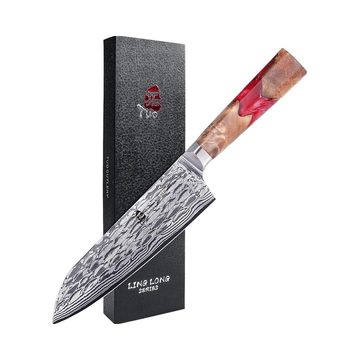
TUO Kitchen Pro 7-inch Santoku
AUS-10 Damascus, 60 HRC. Free US shipping. 30-day returns, return shipping paid by the customer.