AUS-10 Steel Explained: Composition, Hardness and Care
AUS-10 is a Japanese stainless steel used for kitchen and pocket knives. This guide explains what is in it, what a hardness rating of 58 to 60 HRC means, how it compares with AUS-8 and VG-10, and how to look after an AUS-10 knife.
Short answer
- AUS-10 is a stainless knife steel with roughly 1 percent carbon and 13 to 14.5 percent chromium, made in Japan.
- It is typically quoted at 58 to 60 HRC, which is hard enough to hold an edge well and still sharpen on ordinary whetstones.
- It is stain-resistant, not stain-proof, so it still needs to be washed and dried after use.
- It has similar carbon content to VG-10 and slightly more than AUS-8.
What is AUS-10?
AUS-10 belongs to the AUS family of Japanese stainless steels, which also includes AUS-8. One retailer’s steel profile lists Aichi in Japan as the maker. Wikipedia’s list of blade materials describes AUS-10 as comparable to 440C, with a carbon content close to 1.10 percent, and as slightly tougher than 440C. Kitchen knife makers choose it because it combines a reasonably hard edge with stainless corrosion resistance at a moderate price.
Composition
| Element | Typical range | What it does |
|---|---|---|
| Carbon | 0.95 to 1.10% | Allows the steel to be hardened, which supports a lasting edge |
| Chromium | 13.0 to 14.5% | Forms a protective film that resists corrosion; steel needs at least 10.5% to count as stainless |
| Molybdenum | 0.10 to 0.30% | A minor addition; molybdenum also improves resistance to pitting corrosion |
| Vanadium | 0.10 to 0.25% | A minor alloying addition |
These ranges come from a retailer’s steel profile, which cites third-party data, and can differ slightly between producers and specification sheets. Treat them as typical, not exact.
What 58 to 60 HRC means
HRC is the Rockwell C hardness scale. It measures how deeply a diamond cone presses into the material under a set load, and a higher number means a harder material. Wikipedia lists quality knife blades among very hard steels in the HRC 55 to 66 range.
For a kitchen knife, higher hardness generally means the edge stays sharp longer, and the trade-off is lower toughness: a very hard thin edge is less forgiving of twisting, bones and frozen food. Hardness is set by heat treatment as well as by the steel, so two knives in the same steel can differ. The figure on a listing is the maker’s claim.
How AUS-10 compares
| Steel | Carbon | Notes |
|---|---|---|
| AUS-8 | About 0.75% | Comparable to 440B; slightly softer than AUS-10 |
| AUS-10 | About 0.95 to 1.10% | Comparable to 440C; slightly harder than AUS-8 with improved edge retention |
| VG-10 | About 1.0% | Contains cobalt and vanadium; popular for kitchen knives |
AUS-10 and VG-10 have similar carbon content. The name on the spec sheet tells you less than the heat treatment and the blade geometry do, so judge a knife by its hardness figure, edge angle and how it feels in the hand as well as by the steel.
Stainless steels such as AUS-10 resist corrosion because of their chromium content, which is the main reason most kitchen knives are stainless; carbon steels corrode more easily and need drying after use.
Strengths and limits
- Balanced. It combines good edge retention with corrosion resistance and straightforward maintenance.
- Sharpens on ordinary stones. A 1000 grit stone followed by a finer stone is enough; see the sharpening guide.
- Not stain-proof. Stainless steel can still rust if left wet or in contact with salt and acids for long.
- Not the hardest option. Some steels reach higher hardness; they often come with trade-offs in toughness, price or ease of sharpening.
How to read a knife spec sheet
- Steel and hardness. Look for the steel name and an HRC figure together.
- Construction. Is it a single steel, or a core with layered steel on the sides? The edge steel is the one that matters most for cutting.
- Bevel. Double-bevel knives are sharpened on both sides and are generally simpler to sharpen at home than single-bevel knives.
- Length and thickness. Longer blades reach more; thinner blades slice with less drag but are easier to chip.
- Handle and fit. Check the material, the way it joins the blade and how it balances.
- Support. Look for a stated warranty and a clear return policy.
For example, the TUO Kitchen Pro 7-inch Santoku is listed with AUS-10 steel at 60 HRC and a resin and wood handle, based on the manufacturer’s data.
Looking after an AUS-10 knife
Wash by hand, dry the blade straight away and store it with the edge protected. Hone lightly to keep the edge aligned and sharpen on a whetstone when honing no longer helps. The care guide covers cleaning, rust and storage in more detail, and honing vs sharpening explains the difference between the two maintenance steps.
Frequently asked questions
Is AUS-10 stainless steel?
Yes. With about 13 to 14.5 percent chromium it is well above the 10.5 percent minimum for stainless steel. Stainless still needs washing and drying, because it is stain-resistant rather than stain-proof.
How hard is AUS-10?
It is typically quoted at 58 to 60 HRC. The exact figure depends on the heat treatment used by the maker.
Is AUS-10 better than VG-10?
They have similar carbon content. Heat treatment and edge geometry affect how a knife performs as much as the name of the steel.
Does AUS-10 rust?
It resists rust better than carbon steel, but it can still spot if it is left wet. Dry the knife straight after washing.
Sources
Key facts come from these pages. Practical advice and worked examples in the text go beyond them and are not quotations from them. Specifications for any one knife are the manufacturer’s to confirm.
- AUS-10 steel profile, Knives and Stones
- List of blade materials, Wikipedia
- Stainless steel, Wikipedia
- Rockwell scale, Wikipedia
- Japanese kitchen knife, Wikipedia
Related guides
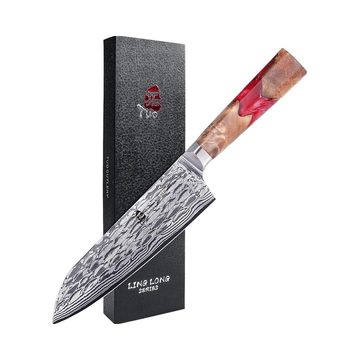
TUO Kitchen Pro 7-inch Santoku
AUS-10 Damascus, 60 HRC. Free US shipping. 30-day returns, return shipping paid by the customer.